


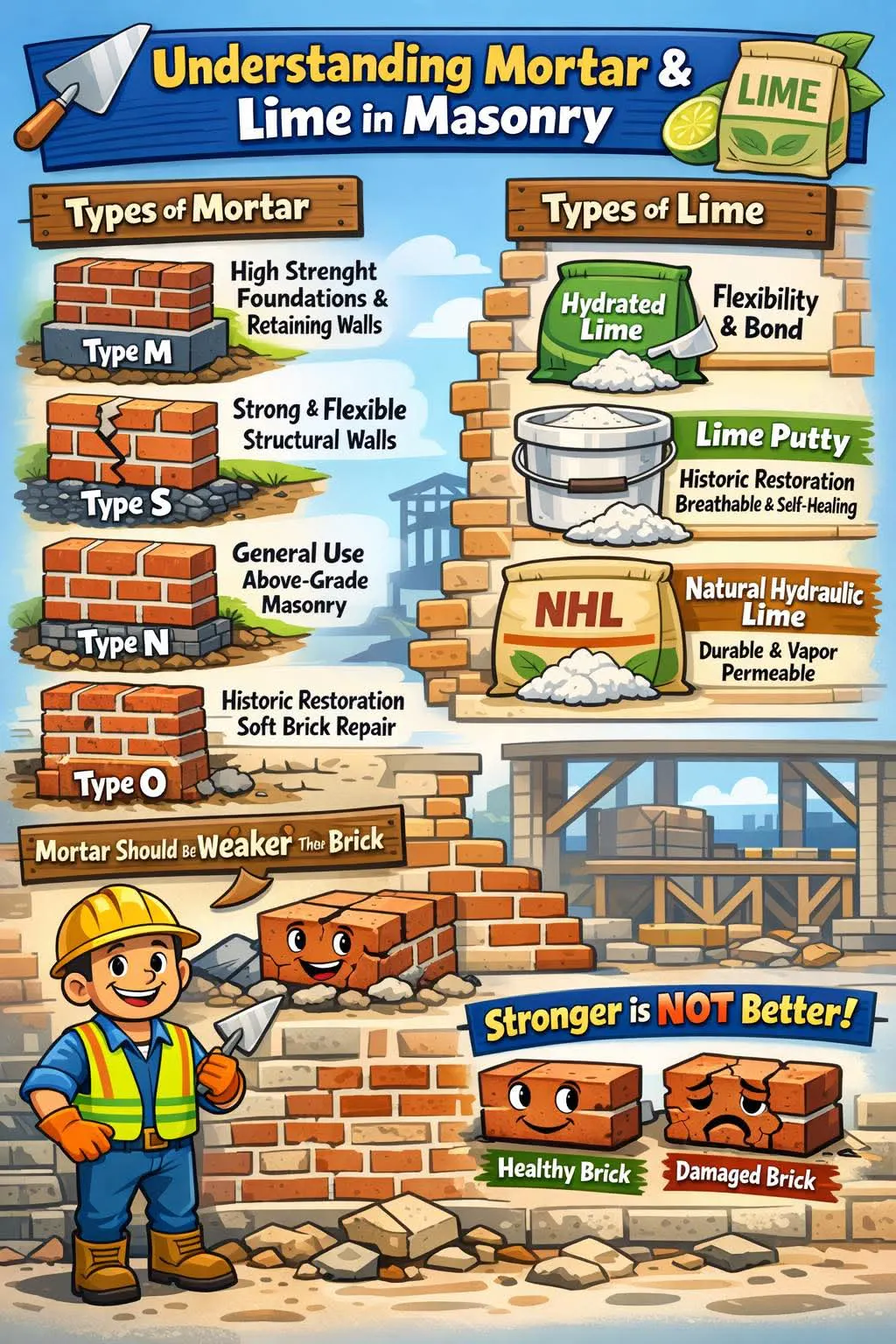
All about Mortar Types - from our friends over at Curatola Masonry
*******************
Mortar Isn’t Just “Mortar” — It’s a System 🧱
One of the most misunderstood parts of masonry is mortar.
It’s often treated as filler — but in reality, it’s the sacrificial, structural, and breathable component of the wall.
Using the wrong mortar can cause cracking, spalling, trapped moisture, and premature failure — especially in historic masonry.
Here’s a clear breakdown 👇
Common Mortar Types (ASTM C270)
Type M
• Highest compressive strength
• Used for foundations, retaining walls, and below-grade work
• Too hard for most historic brick
Type S
• High strength with flexibility
• Used for structural walls, seismic zones, and exterior load-bearing applications
Type N
• The most common modern mortar
• Balanced strength and workability
• Ideal for general above-grade residential masonry
Type O
• Low strength, high flexibility
• Used for historic soft brick and restoration
• Allows the brick to move and breathe
Type K
• Very low strength
• Rare, but used for delicate historic preservation where brick is extremely soft
Lime: The Original Binder
Before Portland cement, masonry relied on lime — and many historic buildings are still standing because of it.
Hydrated Lime (Type S or SA)
• Improves workability and bond
• Adds flexibility and vapor permeability
• Used in modern lime-modified mortars
High-Calcium Lime (Lime Putty)
• Traditional historic mortar
• Extremely breathable and self-healing
• Ideal for restoration of 18th–19th century masonry
Natural Hydraulic Lime (NHL 2, 3.5, 5)
• Sets through hydration and carbonation
• Strength varies by grade
• Used where durability and breathability must coexist
The Key Rule in Masonry
Mortar should always be weaker than the masonry unit.
You want the mortar to fail — not the brick or stone.
That’s not old-school thinking.
That’s long-term performance thinking.
Materials matter.
Compatibility matters.
Craftsmanship starts before the first unit is laid.
#Masonry #HistoricPreservation #Restoration #LimeMortar #ConstructionKnowledge #BuildingScience #Craftsmanship #Trades #StructuralMasonry #Brickwork #Stonework #Architecture #ConstructionEducation